
 AI Tools
 Health
 Math
Math Everyday Life
 Finance
 Physics
 Chemistry
 Statistics
 Construction
 Pets
Pets Time & Date
 Conversion Calculator
 Sign In
Follow Us On:
Follow Us On:
Enter integers or decimals, select an arithmetic operation, and instantly get results for addition, subtraction, multiplication, and division.
Related
Use our free Integer Calculator to quickly add, subtract, multiply, or divide integers and get accurate results instantly. This tool also helps you understand how signs affect integer operations, making it a reliable calculator for positive and negative numbers.
Let’s explore the basics of integers and the rules for performing arithmetic operations.
An integer is a whole number without any fractional or decimal part.
Integers include positive numbers, negative numbers, and zero. You can perform all basic arithmetic operations—addition, subtraction, multiplication, and division—on integers.
Examples:
2, -4, 6, 33333, 9378 are all integers.
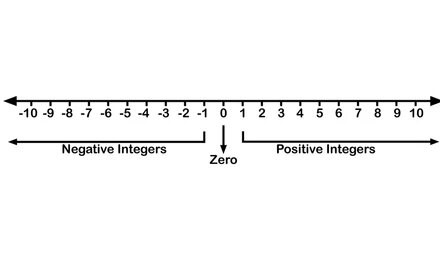
The number line is a visual tool to understand integers. Moving right increases positive numbers, while moving left increases negative numbers. Our consecutive integer calculator uses this principle to perform arithmetic operations for fast and accurate results.
All numbers to the right of zero are positive integers and increase as you move further right.
All numbers to the left of zero are negative integers, which are considered the mirror image of positive numbers.
Our calculator follows these rules for addition and subtraction of integers:
Same Sign: Add the absolute values and keep the common sign.
(+a) + (+b) = a + b
(-a) + (-b) = -(a + b)
Different Signs: Subtract the smaller absolute value from the larger and keep the sign of the larger number.
(-a) + (+b) = b - a
Subtraction follows similar rules with a sign change:
(+a) - (+b) = a - b
(-a) - (-b) = -(a - b)
(-a) - (+b) = -(a + b)
Integer multiplication and division depend on the signs:
Same signs: (+a) × (+b) = a × b, (-a) × (-b) = a × b
Different signs: (+a) × (-b) = -(a × b)
Same signs: (+a) ÷ (+b) = a ÷ b, (-a) ÷ (-b) = a ÷ b
Different signs: (+a) ÷ (-b) = -(a ÷ b)
Positive exponents: ab = a × a × ... × a (b times)
Negative exponents: a-b = 1 / ab
Roots are the inverse of exponents. Even roots of negative integers are not real.
√[a]{b} where b must be positive.
Logarithms of negative integers do not exist; only positive integers can be used.
Example 1: Subtract -7 and -9
(-7) - (-9) = -7 + 9 = 2
Example 2: Add -4 and -7
(-4) + (-7) = -11
Input:
Output:
The largest 32-bit signed integer is 2,147,483,647.
No, integers are infinite. You can always add 1 to get a larger number.
There is no smallest integer; zero is considered neutral.
-1
Zero is neutral because it is neither positive nor negative.
The absolute value is always non-negative; integers may be positive or negative.
Integers are fundamental in math and daily life. This free integer calculator makes arithmetic operations quick, precise, and easy for both positive and negative numbers.
Related
Add this calculator to your site.
×Just copy a given code & paste it right now into your website HTML (source) for suitable page.
Preview:



Easter into Action, Save With Satisfaction
UPTO
50 %
OFF
Give Us Your Feedback
Share Result
Integer Calculator

Links
Home Conversion Calculator About Calculator Online Blog Hire Us Knowledge Base Sitemap Sitemap TwoEmail us at
Contact Us© Copyrights 2026 by Calculator-Online.net
How was your experience today?
Not now
Awesome! Would you mind sharing that on Trustpilot?
Your review helps others find a tool that actually works.
Write a Review on TrustpilotNot now
Sorry to hear that
Tell us what went wrong — we read every message.
Not now
Thanks for your feedback!
We'll use it to make things better.
