
Calculator Online
 AI Tools
 Health
 Math
Math Everyday Life
 Finance
 Physics
 Chemistry
 Statistics
 Construction
 Pets
Pets Time & Date
 Conversion Calculator
 Sign In
Pages
Category
Follow Us On:
Calculator Online
Pages
Category
Follow Us On:
Select the mode, enter the values, and let this fraction calculator solve your fraction problem.
Related
This fraction calculator is used to perform fraction operations such as addition, subtraction, multiplication, and division. It offers two modes, including:
✔️ Simple: It provides a basic input field to perform operations like addition, subtraction, multiplication, and division.
✔️ Advance: It provides mixed number pattern input to get detailed fraction calculation using the same basic operations.
Our tool works with both proper and improper fractions. You can also get the long division steps with a single click when needed. It makes fraction calculations easy and fast for everyone, whether you're solving simple fractions or working with mixed numbers.
“A fraction represents a part of a whole number, object, or quantity using two numbers.”
For Example, \( \frac{1}{6} \) means 1 out of 6 equal parts. Imagine a pizza cut into 6 slices, if you have 1 slice, that is \( \frac{1}{6} \) of the pizza. Fractions like this help us show parts of a whole in everyday life.
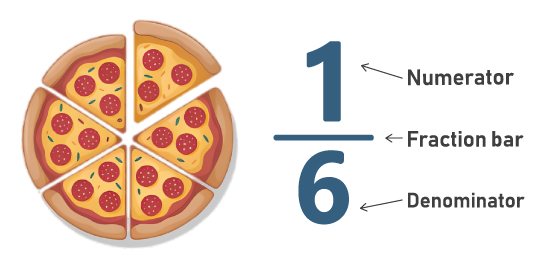
1️⃣ Select the Option: Choose the option from the given dropdown, whether it is 'Simple' or 'Advance'
2️⃣ Enter your Values: Input the numerators and denominators in the designated fields
3️⃣ Select the Operation: Choose addition ( ➕ ), subtraction ( ➖ ), multiplication ( ✖️ ), or division ( ➗ )
4️⃣ Click Calculate: Press the “CALCULATE”, and this fractions calculator will display the result instantly
There are three scenarios to be considered when adding fractions:
When both fractions have the same bottom number, addition becomes very simple. You only add the numerators, while the denominator stays the same.
→ Example
\( \frac{3}{8} + \frac{2}{8} = \frac{3+2}{8} = \frac{5}{8} \)
When a fraction has unlike denominators, start by finding the least common denominator (LCD). To find it, you can use LCD Calculator. After that, convert each fraction and add them.
→ Example
\( \frac{1}{4} + \frac{1}{6} \)
\( \frac{1}{4} = \frac{3}{12} \), \( \frac{1}{6} = \frac{2}{12} \)
\( \frac{3}{12} + \frac{2}{12} = \frac{5}{12} \)
A mixed number includes a whole part and a fractional part, so you should add them accurately.
→ Example
\( 2\frac{1}{3} + 1\frac{1}{6} \)
\(\frac{7}{3} + \frac{7}{6}\) = \(\frac{42}{18} + \frac{21}{18}\) = \(\frac{63}{18}\) = \(\frac{7}{2}\)
Final Answer
\(\frac{7}{2}\) OR \( 3\frac{1}{2}\)
Subtracting fractions follows the same idea as adding them. The steps you follow depends on whether the fractions have the same denominator or different. You can also refer to the fraction addition above for help.
→ Example
\( \frac{5}{8} - \frac{2}{5} = \frac{5×5}{8×5} - \frac{2×8}{5×8} = \frac{25}{40} - \frac{16}{40} = \frac{9}{40} \)
Multiplying fractions is simpler than adding and subtracting fractions because you don't need to have a common denominator. Just multiply the numerator together and the denominator together to get the solution.
→ Example
\( \frac{a}{b} \times \frac{c}{d} = \frac{ac}{bd} \)
\( \frac{5}{7} \times \frac{2}{3} = \frac{10}{21} \)
For dividing fractions, start by flipping the second fraction to get its reciprocal and then multiply the first fraction by this reciprocal. Now, simplify the result if possible. Generally, this method, often called “flip and multiply,” makes fraction division quick.
→ Example
\( \frac{2}{5} \div \frac{3}{7} \)
Step 1: Flip the second fraction (find its reciprocal)
\( \frac{3}{7} \to \frac{7}{3} \)
Step 2: Multiply the first fraction by the reciprocal
\( \frac{2}{5} \times \frac{7}{3}\)
Step 3: Simplify the fraction
\( \frac{14}{15} \)
Handling negative fractions is no different. You can enter negative values and the fraction calculator works out the results. It shows them in improper fractions or simplified forms.
When working with decimals, understanding the powers of 10 is important. This concept simplifies converting fractions to decimals. It also helps convert decimals back to fractions.
For example, to convert the decimal 0.75 to a fraction:
Write the decimal as a fraction: 0.75 = \( \frac{75}{100}\)
Simplify the fraction: Dividing the numerator and the denominator by their greatest common factor. In this case, the greatest common factor is 25. So, you have:
Simplify by dividing numerator and denominator by 25: 75 ÷ 25 / 100 ÷ 25 = 3/4
Use this fractions calculator to add, subtract, multiply, or divide fractions. It finds the least common denominator and simplifies the results for you.
1/2 is a proper fraction and equals 0.5 as a decimal.
Use the fraction to decimal calculator to convert decimals like 0.75 to fractions like
1/4 multiplied by 1/4 equals 1/16.
Copur-Gencturk, Y. (2021). Teachers’ conceptual understanding of fraction operations: results from a national sample of elementary school teachers. Educational Studies in Mathematics, 107, 525–545.
Kalra, P. B., Hubbard, E. M., & Matthews, P. G. (2020). Taking the Relational Structure of Fractions Seriously: Relational Reasoning Predicts Fraction Knowledge in Elementary School Children. Contemporary Educational Psychology, 62, 101896.
This calculator ensures privacy and does not use your input values for any third-party purposes. See our Privacy Policy for more details.
Related
Add this calculator to your site.
×Just copy a given code & paste it right now into your website HTML (source) for suitable page.
Preview:



Easter into Action, Save With Satisfaction
UPTO
50 %
OFF
Give Us Your Feedback
Share Result
Fraction Calculator

Links
Home Conversion Calculator About Calculator Online Blog Hire Us Knowledge Base Sitemap Sitemap TwoEmail us at
Contact Us© Copyrights 2026 by Calculator-Online.net
How was your experience today?
Not now
Awesome! Would you mind sharing that on Trustpilot?
Your review helps others find a tool that actually works.
Write a Review on TrustpilotNot now
Sorry to hear that
Tell us what went wrong — we read every message.
Not now
Thanks for your feedback!
We'll use it to make things better.
